Bobtailed Chihuahuas: History, Genetics, and Why They’re Purebred
Understanding Chihuahua Genetics
A Purebred Trait, an Ancient Mystery, and a Gene Science Has Yet to Name
Not a Defect. Not a Crossbreed. Not the T-Gene.
Natural bobtails appear in Chihuahuas — and they have for as long as the breed has been documented. Yet they remain one of the most misunderstood traits in the breed. Breeders argue about their legitimacy. Scientists have confirmed they exist but can't yet fully explain them. And the gene responsible? It isn't the one everyone assumes. Let's dig into what we actually know.
What Is a Natural Bobtail?
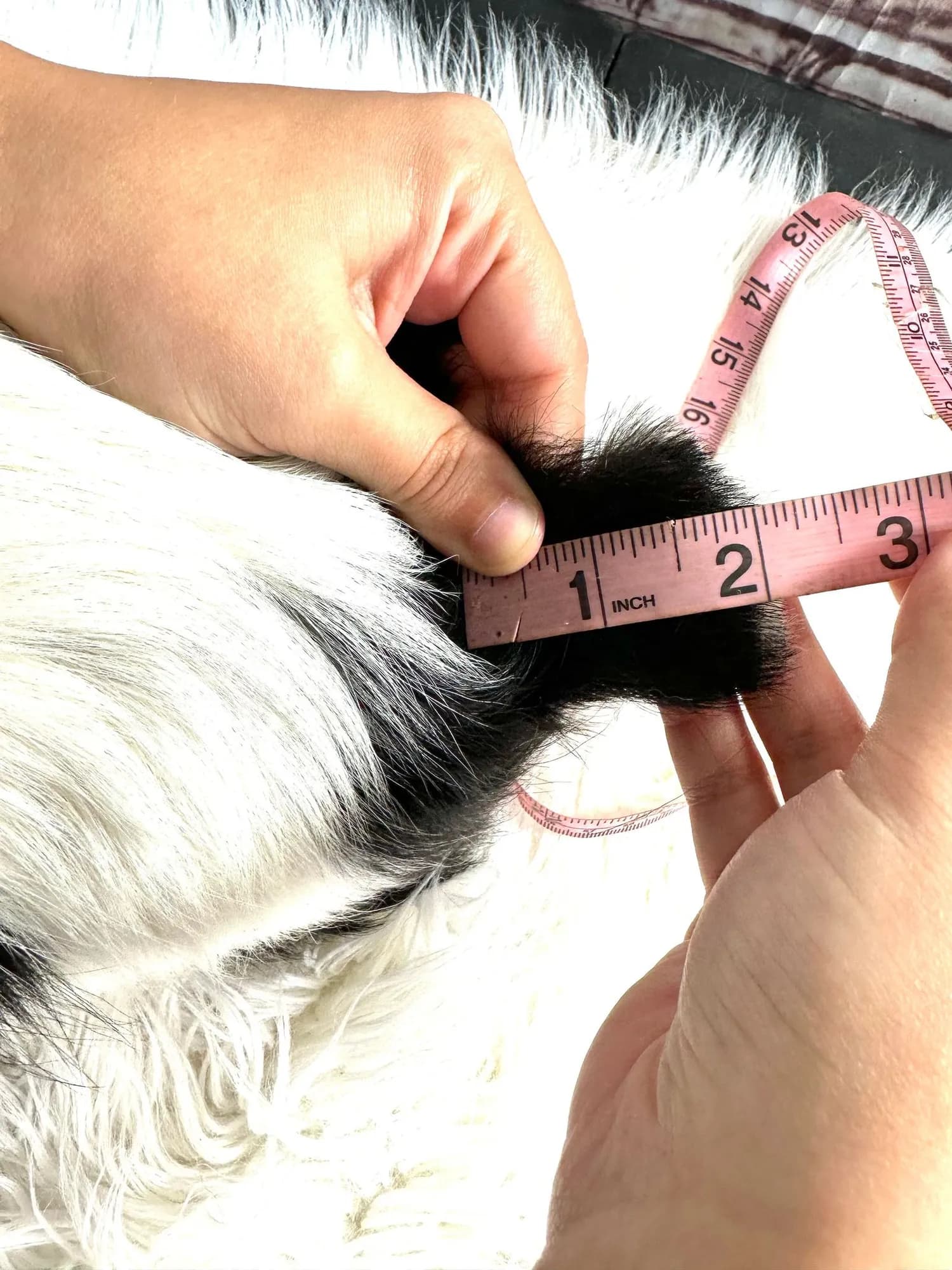
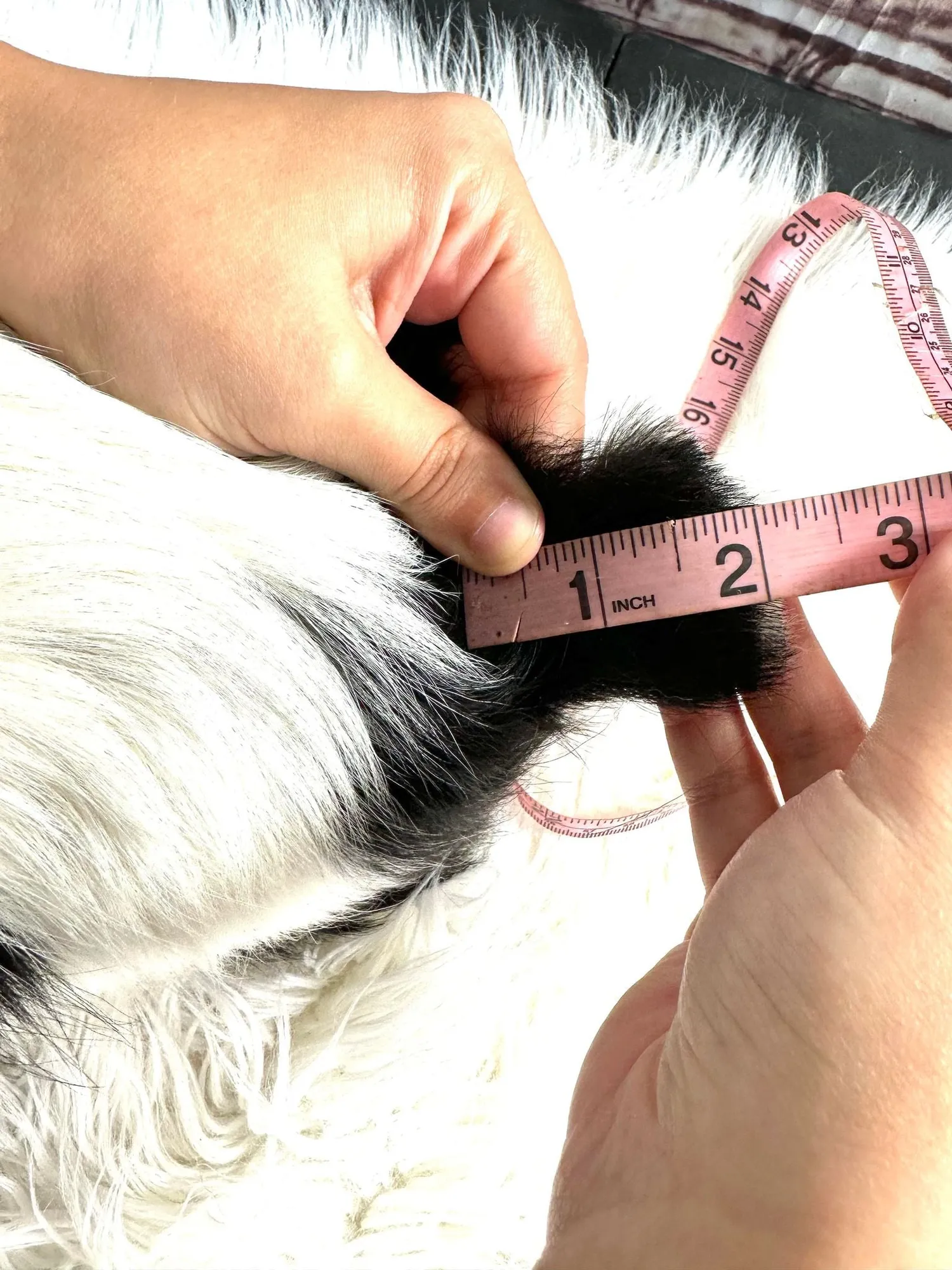
A natural bobtail is a shortened tail present from birth — not the result of docking, injury, or surgical alteration. In Chihuahuas, bobtailed dogs may be born with tails ranging from noticeably short to nearly absent. The trait occurs without any external intervention and has been recognized as a natural variation within the breed for generations.
The AKC breed standard, as documented in Tressa Thurmer's Pet Chihuahua (1962), explicitly recognizes tail variation within the breed, listing moderate-length, sickle-shaped, looped, and naturally short tails as acceptable — provided the tail is natural and unaltered. This is not a new acknowledgment; it reflects a trait that has always existed in the breed.
The 1934 AKC Standard: Bobtails Were Not Against a Good Dog
The AKC Chihuahua breed standard has been revised four times: 1934, 1954, 1972, and 1990. The 1934 standard — the official language approved at the AKC Board of Directors meeting on August 14, 1934 — could not be clearer on the subject of bobtails:
"TAIL — Moderately long, when not a natural bob, or tail-less. Carried sickle, either up or out, but not tucked under. Hair on the tail in harmony with the coat of the body, preferred furry. Bob-tails and tail-less, so born, are not against a good dog."
— AKC Chihuahua Breed Standard, August 14, 1934
The only tail-related disqualification in the 1934 standard was "Cropped tail" — meaning a surgically altered tail. Natural bobtails were explicitly and unambiguously accepted. Not merely tolerated — the standard says they are "not against a good dog."
This language remained in effect through the 1954 revision. It was not until the 1972 revision that "bobtail" was added as a disqualification. That means bobtailed Chihuahuas were fully eligible to compete and win in AKC conformation from the breed's recognition in 1904 all the way through to 1972 — nearly 70 years.
The change did not originate with the AKC. It is the Chihuahua Club of America (CCA) — the AKC-recognized parent club for the breed — that authors and owns the Chihuahua breed standard. The AKC does not write breed standards; it ratifies and enforces what the parent club submits. When bobtail was added as a disqualification in 1972, that decision came from within the CCA membership, and the AKC followed — as it always does — by adopting the parent club's standard. This distinction matters: the bobtail ban was a decision made by Chihuahua breeders, for Chihuahua breeders, as a conformation preference — not a genetic or health ruling imposed from outside the breed community.
Any claim that natural bobtails in Chihuahuas represent crossbreeding or impurity must first reckon with the fact that the breed's own community considered them acceptable for 68 years — and that the standard change in 1972 was a show-ring preference, not a verdict on legitimacy.
Recognized in Breed Literature Since 1962 — and Observed Far Earlier
Natural bobtails are not a recent phenomenon in Chihuahuas. They appear in old show lines — the foundational Victorian and early 20th-century breeding stock that shaped the modern breed. The fact that bobtails cluster in these established lines, rather than appearing randomly across all bloodlines, tells us something important: this trait came with the breed's foundation dogs. It was not introduced later. It was already there.
The T-Gene: What Most Breeds Use — But Chihuahuas Don't
In most dog breeds where natural bobtails occur, the trait is caused by a specific mutation in the T-box transcription factor T gene (C189G), also called the Brachyury gene. This mutation is autosomal dominant — meaning only one copy is needed to produce a shortened tail — and it has been identified in 17 confirmed breeds including the Australian Shepherd, Pembroke Welsh Corgi, Brittany, and Schipperke.
This T-gene mutation, however, comes with an important caveat: it is lethal in the homozygous state. Dogs that inherit two copies (one from each parent) do not survive to birth, resulting in reduced litter sizes when two bobtailed carriers are bred together.
The Science: Not All Bobtails Share the Same Gene
A landmark 2009 study by Hytönen et al. published in the Journal of Heredity tested 23 dog breeds with naturally occurring short tails for the C189G T-gene mutation. The results were unambiguous: while 17 breeds carried the mutation, 6 breeds with confirmed natural bobtails did not carry the C189G mutation at all.
The study concluded: "Given that the T gene mutation is not present in all breeds of short-tailed dog, there must be yet other genetic factors affecting tail phenotypes to be discovered."
This was peer-reviewed, published science acknowledging that unknown bobtail genes exist. Chihuahuas were not in that study — but the evidence suggests they belong in this category of breeds with a different, yet-unnamed mechanism.
Meet Lulu: The Proof in a DNA Certificate
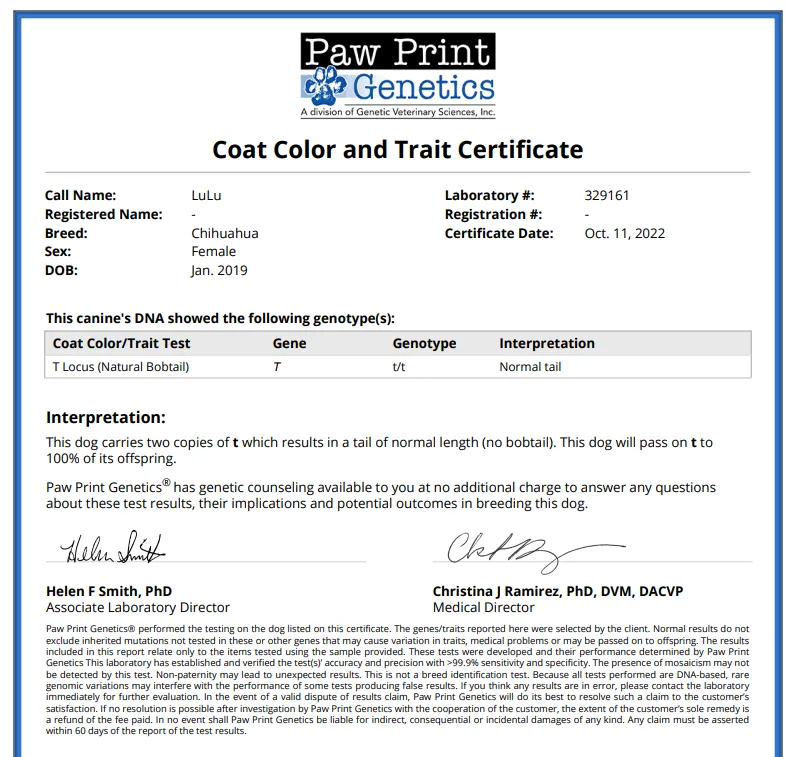
In October 2022, a bobtailed Chihuahua named Lulu was tested for the T Locus (Natural Bobtail) through Paw Print Genetics — one of the most respected canine genetic laboratories in the world. Her results were unambiguous.
Lulu's Official DNA Results — Paw Print Genetics, October 2022
T Locus (Natural Bobtail) Genotype: t/t — Normal Tail
Lulu carries two copies of the standard t allele. She has no copy of the T-gene (C189G) bobtail mutation. She will pass only t to 100% of her offspring — meaning she cannot pass on the T-gene bobtail to any puppy she produces.
And yet — Lulu has a natural bobtail.
This is not a testing error. Paw Print Genetics themselves note on their certificate: "There may be other causes of this condition in dogs and a normal result does not exclude a different mutation in this gene or any other gene that may result in a similar genetic disease or trait." They are directly acknowledging that bobtails can and do occur through other genetic mechanisms.
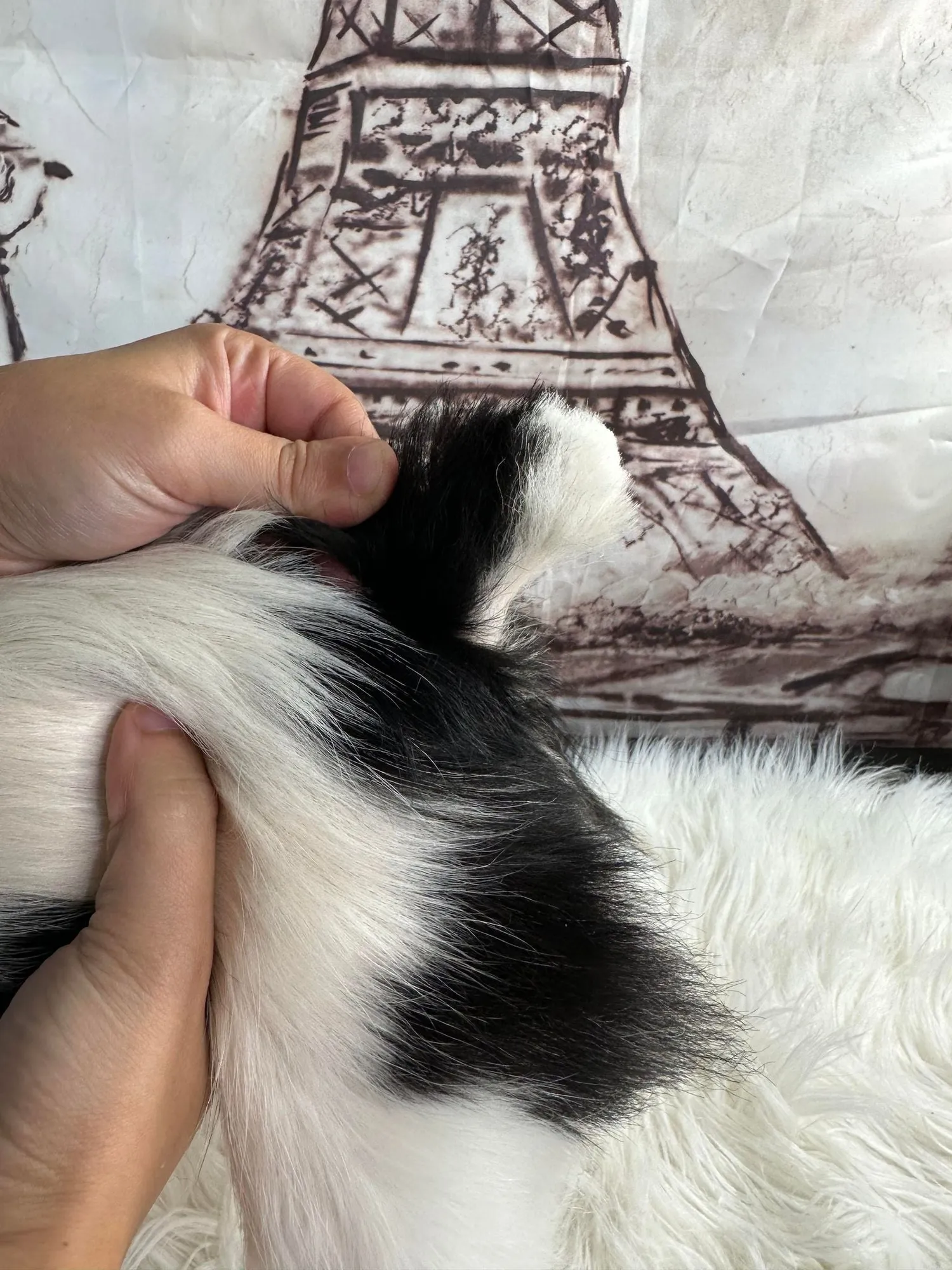
Lulu's case is not an anomaly. It is evidence of a separate, as-yet-unidentified genetic mechanism producing natural bobtails in Chihuahuas — a mechanism that is distinct from the T-gene used by other bobtailed breeds and which does not carry the same litter-size reduction risk associated with the T-gene's lethal homozygous state.
Why Bobtails Appear in Old Show Lines
One of the most telling patterns observed by experienced Chihuahua breeders is that natural bobtails appear most frequently in old show lines — the foundational bloodlines that trace directly to the early formal breeding of the Chihuahua as a recognized show dog in the late 19th and early 20th centuries.
This is not coincidence. If the bobtail trait were a random mutation that had entered the breed recently, we would expect to see it scattered unpredictably across all lines. Instead, it clusters in the oldest, most established breeding stock — the very lines that trace back to the Victorian and Edwardian era dogs that formed the breed's foundation.
What This Pattern Tells Us
If bobtail consistently appears in old show lines, the logical conclusion is that the trait came with those foundation dogs. It was part of the genetic package that built the modern Chihuahua. It was not introduced through crossbreeding. It was not a recent mutation. It has been there from the beginning — carried forward through the same bloodlines that define the breed's show heritage.
Ancient Connections: The Kelb tal-But and European Lineage
To understand where this trait may originate, it helps to look beyond the "discovered in Mexico in the 1850s" narrative of Chihuahua history — a narrative that modern genetic evidence increasingly challenges.
The Malta Pocket Dog — Kelb tal-But
Malta has a long history of small companion dogs. Among them is the Kelb tal-But — literally "Pocket Dog" in Maltese — an ancient, unregistered village dog related to the Maltese purebred. Documented in a 2001 Maltese postage stamp, this small Mediterranean dog was known to come in two varieties: long-tailed and naturally bobtailed.
The existence of a naturally bobtailed small dog in the Mediterranean — in a region with documented ancient connections to the Chihuahua's possible ancestry — is significant. It suggests the bobtail trait in small companion dogs has roots that far predate the Victorian show ring.
What the Haplogroup Data Tells Us
Modern genetic testing includes mitochondrial DNA (mtDNA) haplogroup analysis — a tool that traces the maternal lineage of a dog through geographic populations over thousands of years. Haplogroups function like genetic passports, carrying signatures of where a population's ancestors lived and traveled.
About BreedGuru™
BreedGuru™ is a proprietary breeder tool developed by A & A's Chihuahuas, with generative AI incorporated at its core. Currently in private use, BreedGuru™ will be made available to the public in the coming years. The data presented here is drawn exclusively from the BreedGuru™ master dataset and represents original, proprietary research. All rights reserved.
Analysis of the BreedGuru™ master dataset — a proprietary software platform and breeding database developed by A & A's Chihuahuas, compiling DNA-tested Chihuahuas with structural, health, and genetic data — reveals a striking pattern in haplogroup distribution.
BreedGuru™ Proprietary Dataset: Maternal Haplogroup Distribution (n=60 tested dogs)
| Haplogroup | Count | Percentage | Geographic Origin |
|---|---|---|---|
| A1d | 26 | 43.3% | West Eurasian / European |
| A1a | 13 | 21.7% | West Eurasian / European |
| B1 | 11 | 18.3% | West Eurasian / European |
| C2 | 6 | 10.0% | Specifically European (ancient Neolithic European dogs) |
| A1b | 3 | 5.0% | European (A1b1/A1b2 European-specific lineages) |
| A1e | 1 | 1.7% | West Eurasian |
Paternal haplogroups (n=22 tested): 100% A1a — West Eurasian/European.
Zero pre-Columbian American haplogroups. Zero East Asian haplogroups. Every tested maternal and paternal line traces to European or West Eurasian origins.
The C2 haplogroup deserves special attention. Research published by Duleba et al. (2015) established that sub-haplogroups C2a2 and C2a3 are specifically European in distribution. Ancient European Neolithic dogs from Germany — some over 12,500 years old — were found to belong to haplogroup C. The presence of C2 in 10% of tested Chihuahuas is a direct genetic thread connecting these dogs to ancient European lineages.
This matters for the bobtail question because it reinforces that the bobtail trait appearing in old show lines is not a recent introduction — it is a trait potentially carried forward from the ancient European and Mediterranean foundation dogs that contributed to what we now call the Chihuahua.
An Important Distinction: Two Different Bobtail Mechanisms
Because Chihuahua bobtails appear to work through a different gene than the standard T-gene mutation, this has potentially significant implications for breeders:
| Feature | T-Gene Bobtail (C189G) | Chihuahua Bobtail (Unknown Gene) |
|---|---|---|
| Gene identified? | Yes — T-box transcription factor T | Not yet — under investigation |
| Inheritance | Autosomal dominant | Mechanism not yet confirmed |
| Homozygous lethal? | Yes — BT/BT dies in utero | Not confirmed — may differ |
| Litter size reduction? | ~25-29% when both parents carry | Not yet established |
| Detectable by current DNA test? | Yes — T Locus test | No — tests negative (like Lulu) |
| Breeds confirmed | 17+ breeds | At least 6 breeds (Hytönen 2009); Chihuahua likely among them |
What This Means for Breeders Right Now
Because the gene responsible for Chihuahua bobtails has not yet been identified, we cannot yet test for it directly. A dog that tests t/t (like Lulu) on the standard bobtail panel is NOT carrying the T-gene mutation — but may still carry the unknown Chihuahua-specific bobtail gene.
Until the specific mechanism is identified and a targeted test becomes available, visual assessment and careful pedigree tracking remains the primary tool for monitoring this trait in breeding programs. This is one of the reasons participation in genetic research is so valuable.
Is the Chihuahua Bobtail a Health Concern?
Based on current observations, there is no evidence linking naturally short tails in Chihuahuas to health problems. Dogs like Lulu — bobtailed, t/t tested, and structurally sound — show no associated health issues from their shortened tails.
This is consistent with the fact that the Chihuahua bobtail appears to use a different genetic mechanism than the T-gene, which carries known risks when homozygous. Whether the unknown Chihuahua bobtail gene has any homozygous effects remains to be studied — and is one of the key questions future research needs to answer.
A Call to the Chihuahua Community: Help Solve This Mystery
Lulu's DNA certificate is one data point. To identify the gene responsible for bobtails in Chihuahuas, researchers need more data from more bobtailed dogs — especially dogs from old show lines where the trait is known to appear.
If you own a bobtailed Chihuahua, here is how you can contribute:
- DNA test your dog for the T Locus through Paw Print Genetics or UC Davis VGL and share the results — especially if your dog is bobtailed but tests t/t (negative)
- Document your pedigree — note whether the bobtail appears in old show lines, and how many generations back it traces
- Contact canine genetic researchers — universities with canine genetics programs are actively seeking samples from breeds with bobtails of unknown genetic origin
- Photograph and measure tail length — detailed phenotypic records help researchers understand the range of expression
Every data point moves the science forward. Your bobtailed Chihuahua may hold the key to identifying a gene that has been quietly present in the breed for well over a century.
Key Takeaways
- Natural bobtails are legitimate in Chihuahuas — the 1934 AKC breed standard explicitly states "Bob-tails and tail-less, so born, are not against a good dog." Bobtailed Chihuahuas were fully eligible to show and compete for nearly 70 years. It was the Chihuahua Club of America (CCA) — not the AKC — that added bobtail as a disqualification in 1972; the AKC ratified the parent club's decision, as it always does
- Bobtails cluster in old show lines — suggesting the trait came with the breed's European foundation dogs, not through recent crossbreeding
- It is NOT the T-gene (Brachyury C189G) — Lulu's t/t DNA certificate proves this conclusively for at least one confirmed bobtailed Chihuahua
- Science already knew unknown bobtail genes exist — Hytönen et al. (2009) confirmed that 6 breeds have bobtails not explained by the T-gene
- The haplogroup data is revealing — 100% of tested Chihuahuas in the BreedGuru™ proprietary dataset carry European/West Eurasian haplogroups, including the ancient European C2 lineage, connecting these dogs to the same ancient European populations that also produced small bobtailed companion dogs like the Kelb tal-But
- The specific gene is not yet identified — current bobtail DNA tests will not detect it; this is an open and exciting area of canine genetics research
- No known health concerns — no evidence links naturally short tails in Chihuahuas to health problems, and the unknown gene does not appear to carry the same lethal homozygous risk as the T-gene
- Your participation matters — breeders and owners of bobtailed Chihuahuas can contribute meaningfully to identifying this gene through DNA testing and pedigree documentation
The Bottom Line
The natural bobtail in Chihuahuas is real, historically documented, and genetically distinct from the bobtail mechanism seen in most other breeds. It is not a sign of crossbreeding, a structural defect, or a disqualifying fault. It is a trait that has traveled with this breed's oldest lines — lines that, as haplogroup data increasingly suggests, trace their origins not to Mexico but to ancient European and Mediterranean dogs whose descendants helped shape the Chihuahua we know today.
Lulu's DNA certificate is a single, powerful piece of evidence pointing toward a larger truth that the Chihuahua community — and canine genetics researchers — are only beginning to explore. The gene responsible for this trait is out there, waiting to be found. And the breeders who have quietly been observing bobtails appear in their old show lines for generations may be the ones who help science find it.
Have a bobtailed Chihuahua? We'd love to hear from you. Reach out through our contact page to share your dog's pedigree, DNA results, or photos. Every piece of information helps build the picture.
References
American Kennel Club. (1934, August 14). Official Standard of the Chihuahua — Approved at Regular Meeting of the Board of Directors. AKC Archives. Tail section reads: "Bob-tails and tail-less, so born, are not against a good dog." Cropped tail only disqualification. Natural bobtail remained showable through the 1954 revision.
Kitako Kennels. (2024). Chihuahua History. Standard revised: 1934, 1954, 1972, 1990. https://www.kitacokennels.com/history-of-the-chihuahua
Thurmer, T. (1962). Pet Chihuahua. AKC breed standard documentation including recognition of natural tail variation.
Hytönen, M.K., Grall, A., Hédan, B., et al. (2009). Ancestral T-box mutation is present in many, but not all, short-tailed dog breeds. Journal of Heredity, 100(2), 236–240. https://doi.org/10.1093/jhered/esn085
Haworth, K., Putt, W., Cattanach, B., et al. (2001). Canine homolog of the T-box transcription factor T; failure of the protein to bind to its DNA target leads to a short-tail phenotype. Mammalian Genome, 12(3), 212–218.
UC Davis Veterinary Genetics Laboratory. (2024). Natural Bobtail (T Locus) Testing. https://vgl.ucdavis.edu/test/natural-bobtail
Paw Print Genetics. (2022). Coat Color and Trait Certificate — T Locus (Natural Bobtail), Lulu. Lab #329161, October 11, 2022.
Duleba, A., et al. (2015). Complete mitochondrial genome database and standardized classification system for Canis lupus familiaris. Forensic Science International: Genetics, 16, 44–54.
Bergström, A., et al. (2020). Origins and genetic legacy of prehistoric dogs. Science, 370(6516), 557–564.
Stringer, T.A. (Ongoing). The CM/SM Risk Lineage Study in Chihuahuas. BreedGuru™ Proprietary Master Dataset. A & A's Chihuahuas. All rights reserved.
Thalmann, O., et al. (2013). Complete mitochondrial genomes of ancient canids suggest a European origin of domestic dogs. Science, 342(6160), 871–874.
© 2026 A & A's Chihuahuas. All rights reserved.
This educational content may not be reproduced without permission.