
Alfheim-Andromeda Chihuahuas
Expedition Log · SIPGS · Field Entry 001 Status: On the Trail · Dogs Confirmed: 123 · Continents: 4
The Research Program
N° 01 Breed History · Genetics

The Chihuahua History Project

Expedition · Entry 001

On the trail of the world's smallest dog.

A multi-continent hunt for the Chihuahua's real origin story. From Roman lap dogs and the Silk Road, through 123 DNA tests and the people who carried the dogs across centuries. The trail does not start in Mexico. It ends there.

123

Confirmed Chihuahuas

4

Continents on the trail

0

Pre-Columbian American Y-haplotypes detected

7

Maternal haplogroups identified

01 · The Expedition

The hunt for the breed's actual origin

The Stringer Integrated Pedigree-Genomic Study (SIPGS) is the first Chihuahua DNA study built on dogs with full Embark DNA profiles and a verified country of birth, anchored where possible against AKC and equivalent registry records. That combination is the trailhead. It lets us isolate breed-level genetic patterns and read them cleanly.

The dataset spans the United States, Canada, the United Kingdom, continental Europe, and Mexico. It grows every month as owners and breeders worldwide send their Embark results in. Every dog confirmed adds a checkpoint to the trail. The findings on this page are drawn from the current confirmed sample, and they get sharper with every dog added.

Study at a glance
Study
SIPGS
Sample
123 confirmed Chihuahuas
Sex split
50 males / 72 females
Reach
5 countries, 4 continents represented
Method
Embark whole-genome panel + verified country of birth
Maternal markers
7 haplogroups across the dataset
Paternal markers
1 haplogroup across all confirmed males
Ongoing
Yes. New submissions accepted.

02 · Field Notes

Four discoveries from the trail

A taste of what the data has revealed so far. The full story, with the historical reconstruction that goes alongside it, lives in the forthcoming book.

01 The Bottleneck

Every confirmed male in the study carries the same paternal haplogroup.

Across all confirmed males in the SIPGS dataset, the Y-chromosome lineage is identical. A single founder line, repeated across every male in five countries.

That kind of paternal uniformity is the genetic signature of a small founding population in a relatively short historical window. It tells us something specific about how the breed was assembled, and when.

Full lineage reconstruction · Coming in the book
02 The Missing Marker

The maternal marker once cited as proof of Mexican origin? Not in our dataset.

A widely cited 2013 study reported a particular maternal haplotype in samples described as Chihuahuas, and used that result to argue for pre-Columbian Mexican continuity. The marker appeared in roughly a third of the dogs in that earlier paper. Their breed identity was not independently confirmed.

In the SIPGS dataset of 123 confirmed Chihuahuas across four continents, that same marker has not turned up yet. Not in any of them.

Which marker, and why it matters · Detailed in the book

03 The Silk Road Question

The breed's deep ancestry sits on the same trade routes humans walked for two thousand years.

Long before any of these dogs reached Mexico, Roman writers were already documenting small lap dogs by the name Melitaeus catulus, the Maltese pocket dog. Roman trade reached from the Mediterranean east along the Silk Road, and where Roman trade went, small companion dogs traveled with it.

Wherever humans moved for trade, war, marriage, or escape, they carried their dogs. The maternal lines in the SIPGS dataset run through territory humans were crossing for centuries. The Chihuahua's family tree is also a human migration story.

Rome, the Silk Road, and the human carriers · Coming in the book

04 The Marketing Story

A small dog, a wealthy family's expectations, and the marketing decision that built a fortune.

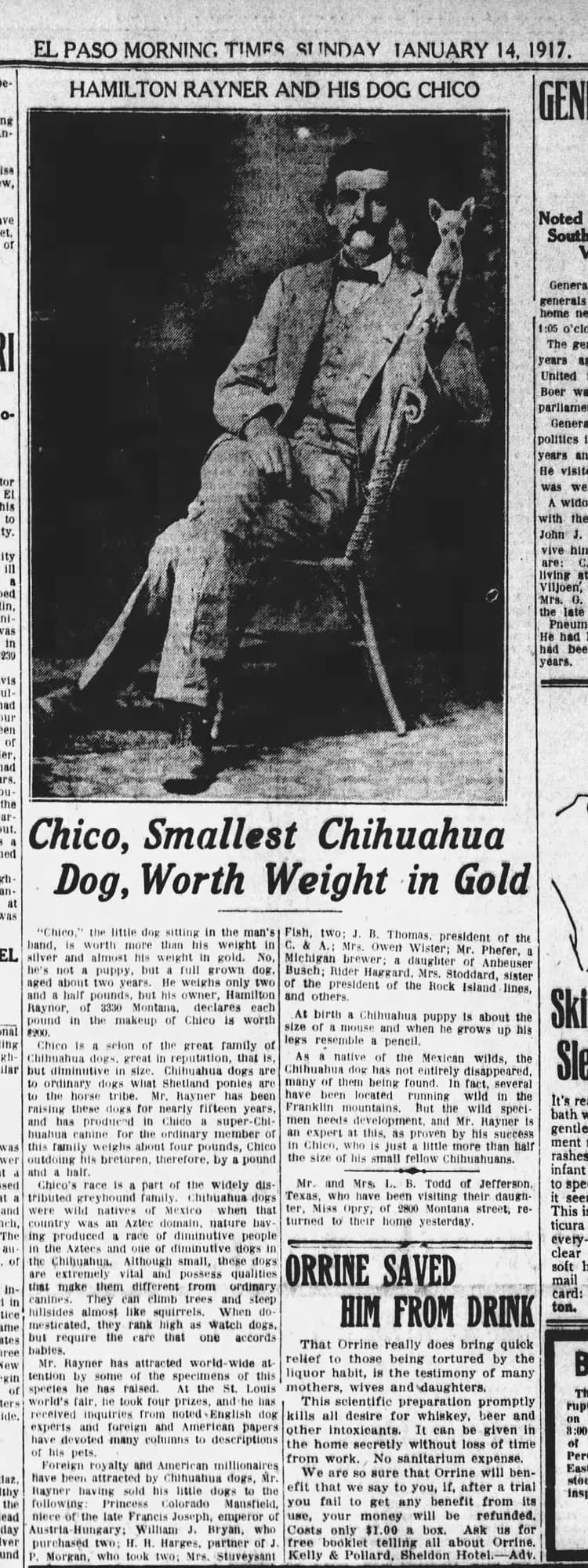
By the late nineteenth century, a Texan named H.P. Rayner had a problem most of his contemporaries would have envied. He came from a wealthy, established family. They expected him to earn his own place in it. He needed a venture of his own, and he had a knack for selling a story.

He found his story in a small dog. He gave it a name with romance and exoticism. He built a market for it in newspapers, postcards, and dog shows. He turned a quiet trade into an empire and his ambition into a legacy. Mexico would later embrace and celebrate the breed into one of its most recognizable cultural symbols. Before that beloved chapter, a young Texan with a name to live up to made the dogs famous.

The Rayner story · A full chapter in the book

Primary sourcePeriod newspaper article featuring H.P. Rayner with his Chihuahua, Chico
From the archives — H.P. Rayner with his Chihuahua, Chico. One of the dogs that built the fortune.
Mexico didn't find the Chihuahua. Mexico chose it.
SIPGS · Working Hypothesis

03 · The Field Journal

The Smallest Dog in the World

From the Silk Road to silk purses

A narrative nonfiction investigation that combines the SIPGS genetic data with primary-source historical reconstruction. Newspaper archives, kennel club records, immigration manifests, Roman writings, and DNA, all illuminating a breed's full journey to its beloved home in Mexico.

Expect the people. Expect the marketing. Expect the longer story behind the world's smallest dog.

Forthcoming · Narrative Nonfiction

The Smallest Dog in the World From the Silk Road to silk purses

Tanya Stringer, FCG, M.Div

04 · Join the Expedition

Add your dog to the trail

If you own a Chihuahua with a full Embark DNA test, you can help expand the dataset. Two things are all we need from you. The pedigree work happens on our end.
  1. 01

    Run a full Embark DNA test

    The complete Embark Breed and Health panel. Other companies don't capture the haplogroup data this study relies on.

  2. 02

    Note your dog's country of birth

    The country your dog was actually born in, not where you live now. This anchors the genetic data to a real geography.

  3. 03

    Email your results

    Share your Embark report (PDF or share link) along with the country of birth.

  4. 04

    Get acknowledged

    Significant contributors are credited by name in both the academic paper and the book, with consent. Pet names and call names are kept private on request.

Submit your dog's data

Send us your dog's data

Email your Embark report and your dog's country of birth to the address below. A real person reads every submission. Expect a reply.

healthresearchataa@gmail.com

What we'll need:

  • Full Embark DNA test results (PDF or share link)
  • Your dog's country of birth
  • Permission to include your dog in the dataset
  • Optional: photos and any health history you'd like considered

05 · How We Hunt

Why the verification matters

The SIPGS approach combines two disciplines that don't usually share a table. Forensic genealogy treats every claim as a question until a paper trail answers it. Population genetics measures what the genome actually shows. Together they catch problems that either method, on its own, would miss.

The dataset is built dog by dog: each one with a full Embark DNA profile and a verified country of birth, anchored against AKC and equivalent registry records on the back end. The result is a sample that is smaller than some published work but tighter, cleaner, and reproducible. Every conclusion on this page is grounded in dogs whose data has been read carefully and crosschecked.

Tanya Stringer

FCG · M.Div · Lead Researcher

Forensic genealogist, breeder, and author. Health committee contributor to the Chihuahua Club of America's quarterly publication. Founder of the SIPGS dataset and BreedGuru, an AI-assisted platform for ethical breeders.

Collaborators

Editors · Contributors · Breeders

The study and forthcoming book draw on contributions from breeders across five countries, two manuscript editors, and a research assistant working through historical archives. A complete acknowledgments list appears in both the academic paper and the book.

06 · Dispatches

What people ask first

So is the Chihuahua a Mexican breed or not?

Mexico is unambiguously the breed's adopted home and cultural center. The Chihuahua is a beloved national symbol there, and that embrace is real and lasting. The DNA evidence and historical record suggest the dog's earlier journey ran through Europe and the United States before reaching Mexico. Both chapters of the story are true. The book and the study fill in the longer journey before the famous part.

How is this different from the 2013 study that argued for Mexican origin?

That study used unverified samples. The dogs were called Chihuahuas, but their breed identity was not independently confirmed. SIPGS only includes dogs with full Embark DNA profiles and verified country of birth. When you control for that, the haplotype the earlier paper highlighted does not appear in the breed itself.

Is this peer reviewed?

The full academic paper is in preparation. The website teases the findings without giving away the underlying analysis. Once the paper is submitted, all citations, raw data tables, and methods will be public. The book will be released alongside or shortly after the paper, written for general readers.

Will my dog's name appear publicly?

Only with consent. Significant contributors are acknowledged by name in the book and paper if they wish. If you'd rather your dog appear only as anonymized data in the dataset, we honor that.

Do I need to be a breeder to contribute?

No. Pet owners with a Chihuahua and a full Embark DNA test are welcome. The only requirements are a complete Embark profile and a verified country of birth.

What does this mean for the breed going forward?

Knowing where a breed actually came from is the foundation for breeding it well. The findings here have direct implications for genetic diversity management, health screening priorities, and how kennel clubs talk about the breed's history. Honest answers don't diminish the dog. They strengthen our stewardship of it.

Selected References

Where the science behind this page lives

  1. van Asch, B., et al. (2013). Pre-Columbian origins of Native American dog breeds, with only limited replacement by European dogs, confirmed by mtDNA analysis. Proceedings of the Royal Society B, 280(1766).
  2. Bergström, A., et al. (2020). Origins and genetic legacy of prehistoric dogs. Science, 370(6516), 557–564.
  3. Pang, J.-F., et al. (2009). mtDNA data indicate a single origin for dogs south of Yangtze River, less than 16,300 years ago, from numerous wolves. Molecular Biology and Evolution, 26(12), 2849–2864.
  4. Leonard, J. A., et al. (2002). Ancient DNA evidence for Old World origin of New World dogs. Science, 298(5598), 1613–1616.
  5. Castroviejo-Fisher, S., et al. (2011). Vanishing native American dog lineages. BMC Evolutionary Biology, 11, 73.
  6. Boyko, A. R., et al. (2009). Complex population structure in African village dogs and its implications for inferring dog domestication history. PNAS, 106(33), 13903–13908.
  7. Thalmann, O., et al. (2013). Complete mitochondrial genomes of ancient canids suggest a European origin of domestic dogs. Science, 342(6160), 871–874.
  8. Manin, A., et al. (2025). Mitogenomes of ancient American dogs. [Forthcoming citation in published book.]